Build with Claude Code

Live & hands-on

John KimSenior Staff Engineer @Meta
What you'll learn

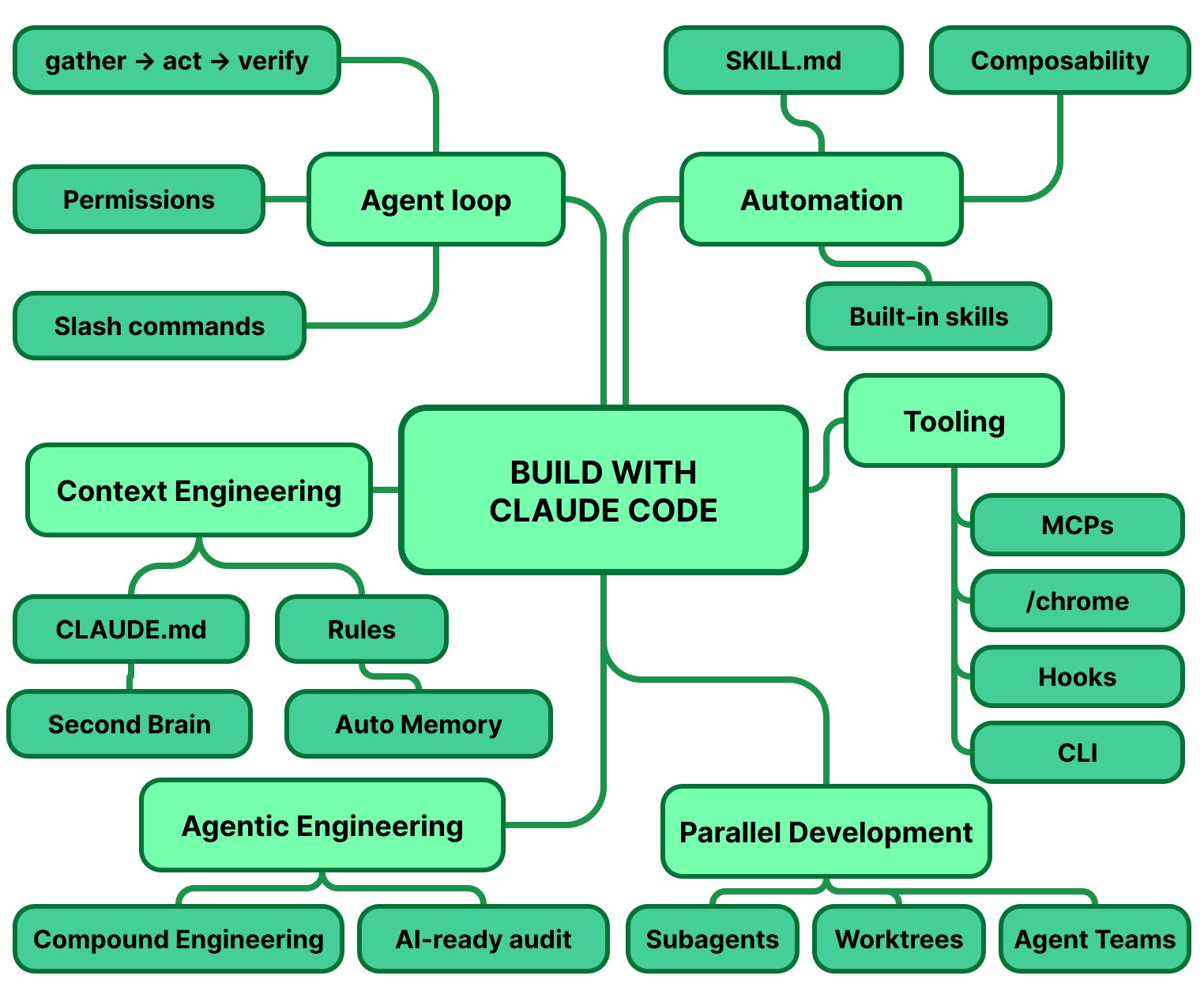
Understand how Claude Code works

  • Master the agentic loop: gather, act, verify
  • Navigate with keyboard shortcuts and slash commands
  • Control permissions from safe mode to full autonomy

Master context engineering

  • Write a CLAUDE.md under 200 lines that transforms Claude's output
  • Watch AI fail, diagnose why, and fix it with rules
  • Build a Second Brain that persists knowledge across sessions

Automate workflows with Skills

  • Turn any repeatable workflow into a one-line command
  • Compose Skills that call other skills
  • Build a suite of 3-4 reusable skills for your team

Connect Claude to external tools

  • Install and scope MCP servers for real data sources
  • Automate the browser with /chrome screenshots and console reads
  • Build self-correcting chains that catch and fix their own bugs

Run parallel AI agents

  • Manage 2-3 Claude instances at once with git worktrees
  • Choose between subagents, agent teams, and separate instances
  • Build a full-stack app in parallel in a single assignment

Get out of the loop

  • Audit your codebase for AI-readiness with the Five Pillars
  • Wire hooks so agents validate work unattended
  • loops, goals, and graph engineering
  • Ship a real feature where agents execute and you review the PR

Course Outline

Session 1
Wednesday, September 16, 20265-7 PM PT Live Session7-7:30 PM PT Live Q&A

Claude Code Fundamentals

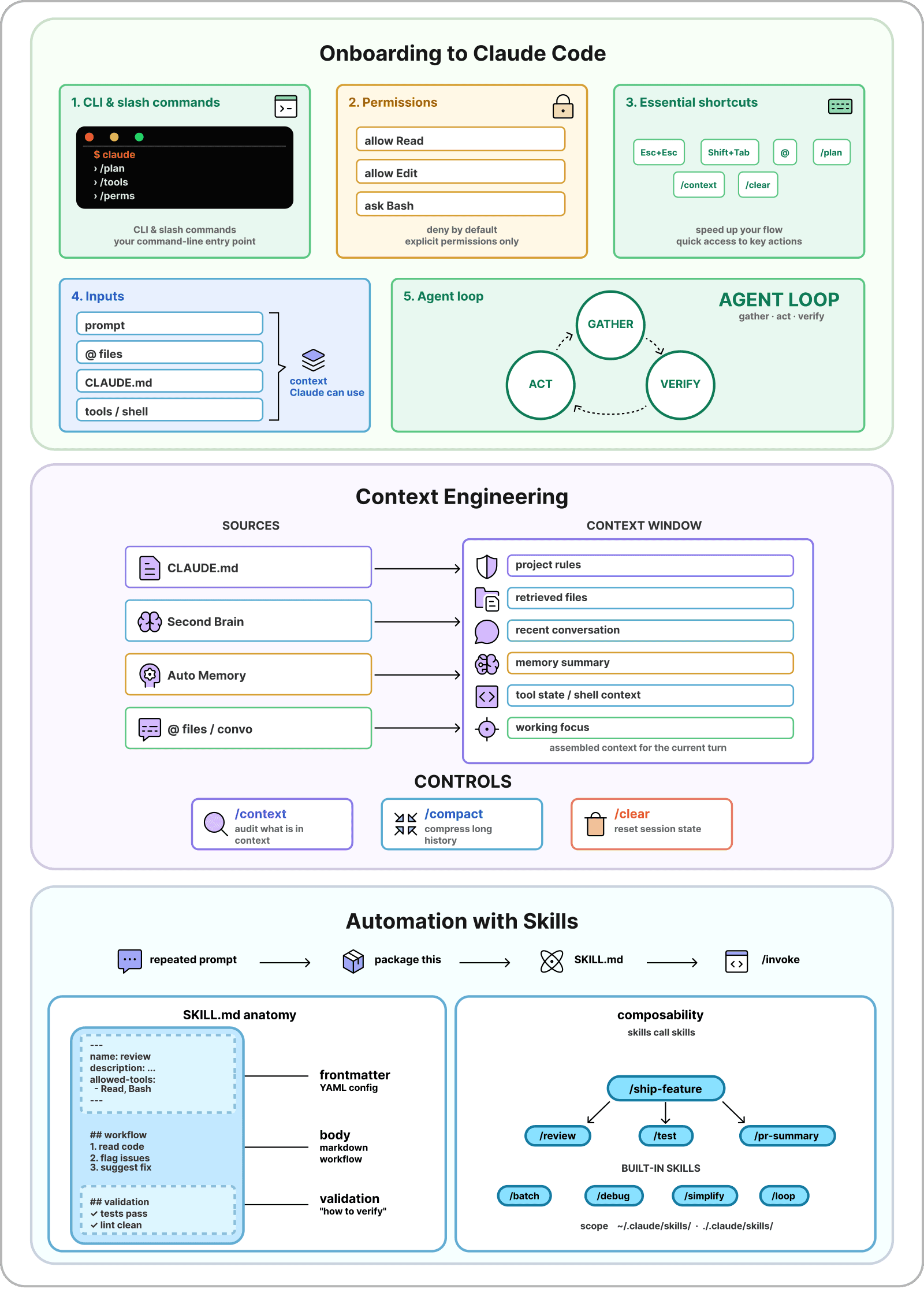
Claude Code Basics

  • The agentic loop (gather → act → verify)
  • Installation and your first interactive session
  • Slash commands and keyboard shortcuts
  • The permission system (Default, acceptEdits, plan, dontAsk, bypassPermissions)

Context Engineering

  • The context window as a finite working memory
  • The "fresh and condensed" principle
  • Context management commands
  • Layers of memory: CLAUDE.md, Second Brain, Auto Memory
  • Lazy loading

Automation with Skills

  • Skills as reusable workflows and the anatomy of a SKILL.md
  • Skills creation vs. Built-in skills
  • Composability (skills that call other skills)
Claude Code Fundamentals diagram
Assignments
Self-pacedRecorded walkthrough

Practice the Foundations

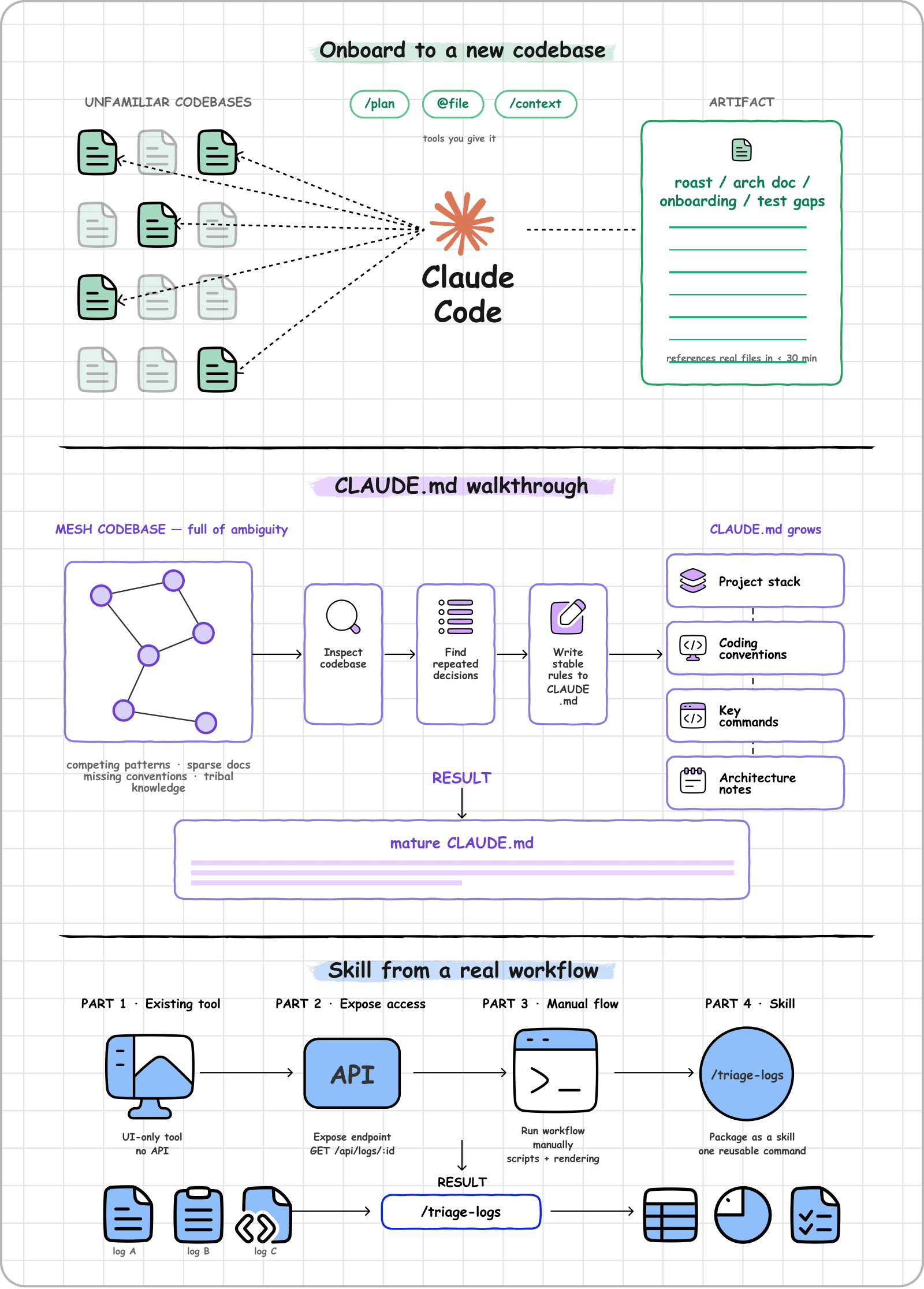
Onboard to a New Codebase

  • Point Claude Code at an unfamiliar repo
  • Use plan mode to explore before acting
  • Produce a useful artifact: roast, architecture doc, onboarding guide, or test gap analysis
  • Verification

CLAUDE.md (the mesh walkthrough)

  • Initialize CLAUDE.md
  • Write canonical patterns and migrate the legacy code
  • Build a search feature from a senior-engineer spec on clean conventions
  • Translate a designer email (violet/lime accents) into a durable rule

Skill from a real workflow (log triage)

  • Take stock of a UI-only log archive and identify the automation gap
  • Add an API endpoint to expose the tool to Claude
  • Author a markdown report template using documented placeholders
  • Run the pipeline manually: curl → parse → filter → categorize → aggregate → render
  • Wrap the entire flow as a new skill: /triage-logs <log-id>
  • Run the skill on a fresh log with no re-prompting
Practice the Foundations diagram
Session 2
Thursday, September 17, 20265-7 PM PT Live Session7-7:30 PM PT Live Q&A

Scaling Up with MCPs, Parallel Agents, and Agentic Engineering

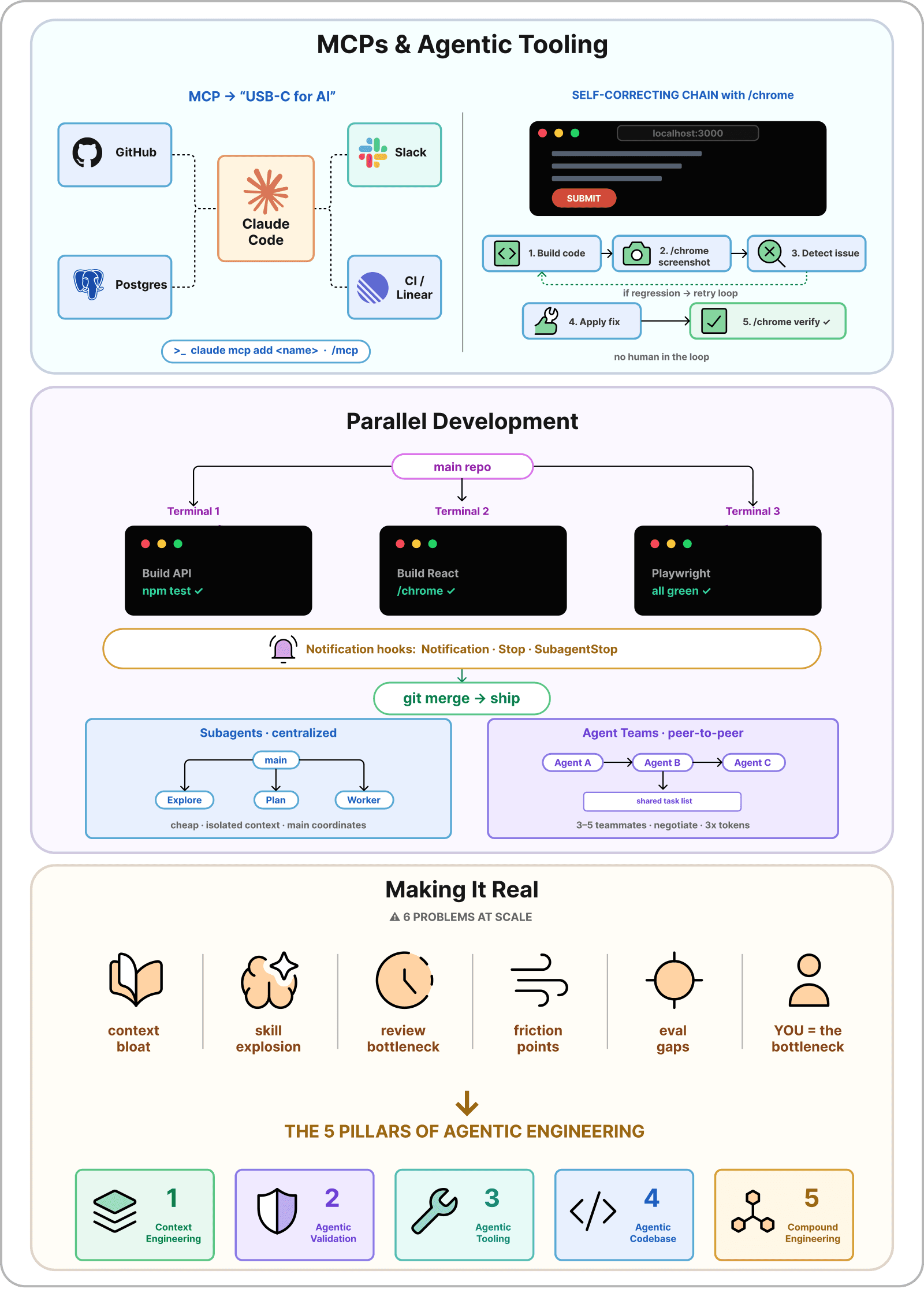
MCPs, CLIs, and Agentic Tooling

  • Model Context Protocol (MCP) and installation
  • When NOT to use MCP (token cost, output limits, signal-to-noise)
  • Browser automation with /chrome (navigate, screenshot, read console, record GIFs)
  • The self-correcting chain with no human in the middle (build → screenshot → detect → fix → verify)
  • Agentic engineering
  • Hook lifecycle

Parallel Development and Agentic Validation

  • Git worktrees (claude --worktree) for safe parallel isolation
  • The multi-agent workflow (managing a team of Claudes)
  • Subagents (centralized, lower-cost) vs Agent Teams (peer-to-peer, higher-cost)
  • Notification hooks (Notification, Stop, SubagentStop, StopFailure)
  • /chrome in parallel workflows for automated visual regression

The Five Pillars of Agentic Engineering

  • Common challenges at scale (context bloat, skill explosion, review bottleneck, friction points, evaluation gaps, you-as-the-bottleneck)
  • Techniques to build at scale
  • Compound engineering
  • Auditing your codebase for AI-readiness
  • Designing harnesses to eliminate friction
Scaling Up with MCPs, Parallel Agents, and Agentic Engineering diagram
Assignments
Self-pacedRecorded walkthrough

Build at Scale

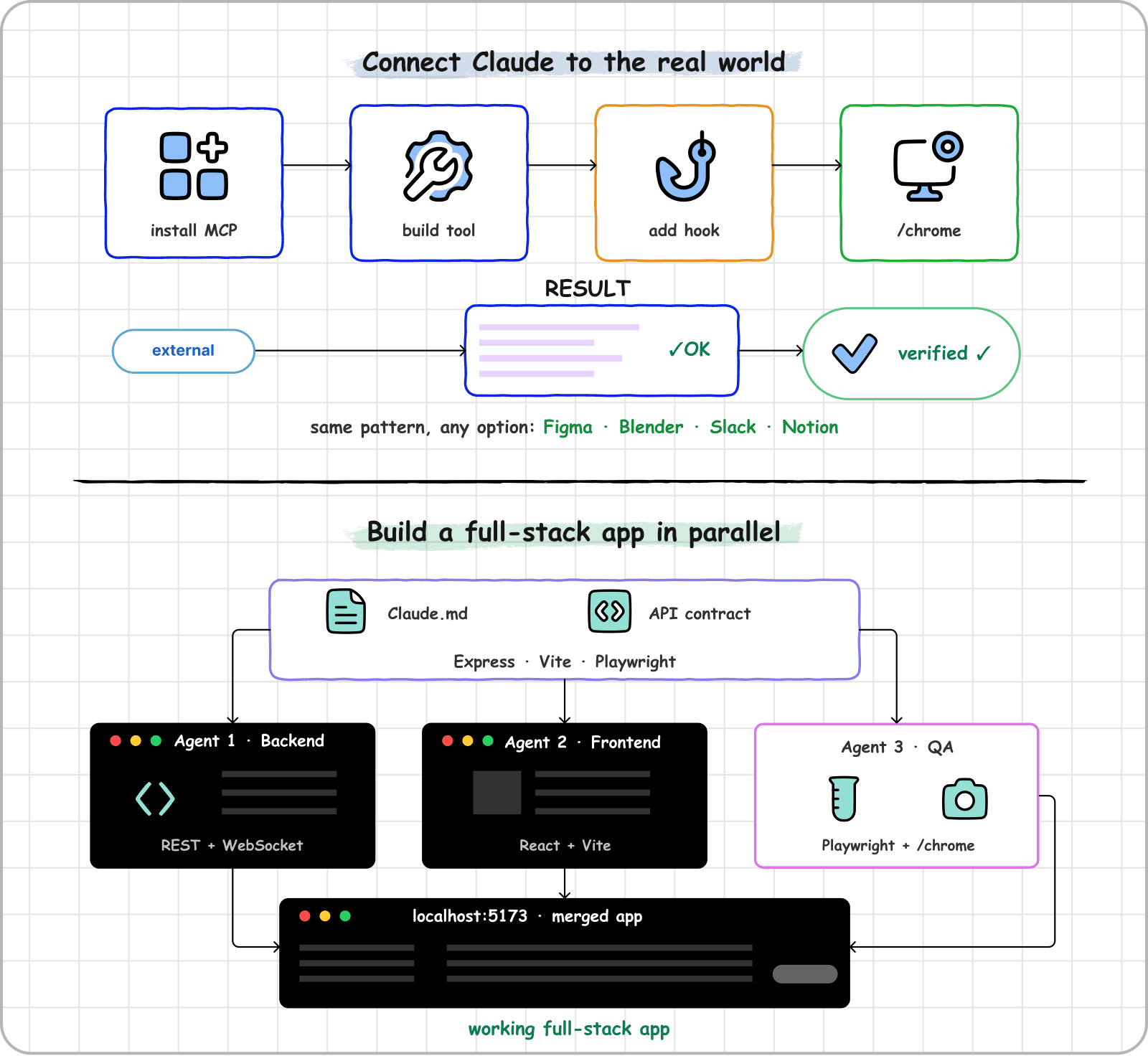
Connect Claude to the Real World with MCPs

  • Install MCP servers (Figma, Blender, Slack, or Notion)
  • Build a tool that reads from and writes to an external system via MCP
  • Add validation hooks that check the tool's output automatically
  • Use /chrome to visually verify the built interface or output

Build a Full-Stack App in Parallel

  • Set up a shared CLAUDE.md with stack, ports, and API contract
  • Run Claude instances simultaneously in separate worktrees (backend, frontend, tests)
  • Decompose a full-stack app into independent tasks suitable for parallel agents
  • Merge worktree branches together, resolving at least one conflict in the process
  • Use /chrome to validate the merged frontend renders and functions correctly

Capstone

  • Pick a project you actually want to ship: your own repo, a side project, or one of three starter PRDs (CodeCoach, Korridor, or Wordle iOS). Your stack, your language.
  • Write a CLAUDE.md, scope .claude/rules/, and build a Second Brain so Claude never has to ask for context.
  • Set up a validation harness with tests, linting, hooks, and /chrome so Claude can self-check and self-correct.
  • Wire up agentic tooling, including MCPs, 2–3 reusable skills, and project slash commands that help your agents do more on your behalf.
  • Define agent team roles and accelerate your development workflow.
Build at Scale diagram
Optional Office Hours

Drop in with questions about the material or your project. Entirely optional.

Wed, Sep 23 · 5–7 PM PT
Drop in with questions about the material or your project. Entirely optional. diagram

Meet Your Instructor

John Kim

John Kim

John Kim is a Senior Staff Software Engineer at Meta with over a decade of industry experience across mobile, cloud, and full-stack web development. He has trained hundreds of Meta engineers in how to use Claude Code effectively, moving teams beyond AI autocomplete and into real agentic workflows that ship code to production.

In this course, John draws on everything he has learned, from the fundamentals of Claude Code to the advanced production workflows he uses every day. He shows how Claude Code fits into the bigger shift that is occurring in our industry: the rise of agentic engineering. By the end of the course, students will know the tool well and will have learned to think like agentic engineers.

Meta

Prerequisites

  • Claude Pro subscription.
  • Some experience with AI coding tools like Cursor, Copilot, or Claude will help you get the most out of the course.
  • Basic terminal and git skills.

What You’ll Get

Live & Interactive Sessions

Learn directly from the instructor in real time. Ask questions, receive feedback, and stay engaged.

Peer Community

Stay motivated and accountable with a group of peers who are learning alongside you.

Certificate of Completion

Showcase your achievement on LinkedIn. Proof that you’ve leveled up with real-world skills.

The ByteByteGo Guarantee

If the membership isn’t the right fit, you can request a full refund within 7 days of purchase, as long as you haven’t completed a course.

FAQs

Every session is recorded, so you can catch up anytime that works for you.

This is a 2-day intensive. You’ll join two live sessions of 2 hours each (4 hours total), plus 3–5 hours of assignments to practice what you’ve learned. Plan for roughly 8–10 hours overall.

Yes. Every session is recorded, so you can catch up anytime. Most of our students are working professionals, and the course is designed with that in mind.

Many members expense it through their company’s learning and development budget. We provide an invoice you can submit and an email template you can send to your manager. Get the email template →

Once you enroll, you’ll keep access to your cohort’s recordings and course materials even after the live sessions end, so you can revisit lessons anytime.

Reach out to live-courses@bytebytego.com. We’ll get back to you within 24 hours.